Monday, 16 June 2025

Friday, 2 May 2025
The Fascinating History of Hearing Aids
The Fascinating History of Hearing Aids: From Trumpets to Technology
Hearing aids have a rich and surprising history that spans centuries—from the large, ornate ear trumpets of the 17th century to the sleek, AI-powered devices of today. Let’s take a colorful journey through the evolution of hearing technology.
1. The Era of the Ear Trumpet (17th – 19th Century)
Before electronics, amplification was entirely mechanical. The ear trumpet was the first widely used hearing aid, funneling sound directly into the ear.
These trumpets came in various shapes—some extravagant, others designed to be concealed in hats or furniture.
Though rudimentary, they marked humanity’s first major step in assisting hearing loss.
2. The Rise of Electric Hearing Aids (1898 – 1940s)
The invention of the telephone and microphone sparked a revolution in hearing technology. In 1898, Miller Reese Hutchison created the Akouphone, the first electric hearing aid.
Early devices were bulky, required large batteries, and were often worn around the neck or in handbags. Despite their size, they offered better amplification and were more effective than ear trumpets.
3. The Vacuum Tube Age (1920s – 1950s)
Vacuum tubes allowed for greater amplification and portability. Hearing aids became smaller and could be clipped to clothing.
These devices brought significant improvements in sound clarity and volume, though they still required external battery packs.
4. The Transistor Breakthrough (1950s – 1970s)
The invention of the transistor transformed electronics—and hearing aids. By the 1950s, hearing aids became compact enough to fit behind the ear.
These devices were more durable, energy-efficient, and discreet, making hearing assistance more accessible to the masses.
5. The Digital Revolution (1980s – Early 2000s)
Digital signal processing changed everything. Instead of simply amplifying sound, digital hearing aids could filter background noise and enhance speech clarity.
This era saw the rise of programmable hearing aids, tailored to individual hearing profiles.
6. Smart & AI-Powered Hearing Aids (2010s – Present)
Modern hearing aids are technological marvels. They connect to smartphones, use AI to adapt to environments, and offer real-time language translation and health tracking.
Brands like Oticon, Phonak, and Starkey now design devices that double as wearable tech—discreet, powerful, and packed with features.
The Future: Brain-Computer Interfaces & Regenerative Medicine?
Researchers are exploring brain-computer interfaces and regenerative therapies that may one day eliminate the need for hearing aids altogether.
The goal is clear: to seamlessly restore hearing without external devices.
A Legacy of Innovation
From elegant brass trumpets to AI-driven microcomputers, the history of hearing aids is a testament to human ingenuity. Today, these devices not only restore hearing—they empower people to connect, communicate, and thrive in a noisy world.

Thursday, 1 May 2025
SIGNIA RECHARGEABLE HEARING AIDS
ORION from Signia is becoming a favourite hearing aid.
It is one of the SIGNIA family of hearing aids which is becoming very popular especially due to it's features at so economical price range.

Wednesday, 30 April 2025
HEARING AID REPAIRS
When we use hearing aids, it is obvious to keep its working efficiency optimum.
People using hearing aids face tremendous difficulties in getting their hearing aids fixed in minimum time and money.
We are providing our services to get the hearing aids promptly repair and at a reasonable price with its optimum efficiencies.

Saturday, 26 April 2025
ORION, Signia Rechargeable Hearing Aids
Orion Charge&Go
Effortless. Elevated. Enhanced.

At Signia, we believe everyone is entitled to a high standard of hearing care. With Orion Charge&Go, we’re making excellence accessible for all with a hearing aid that raises the bar for ease of use, design, and technology.

ns to Cion ha Go
ns to Cion ha Go
ns to Cion ha Go
Six reasons to choose Orion Charge&Go
Rechargeability for all
Farewell to the hassle of small batteries.
Hello rechargeability.
Contemporary design
Farewell yesterday’s design.
Hello today’s style.
Dust and sweat resistant
Farewell to worries about dust and sweat.
Hello to dependable performance.
Clarity in quiet
Farewell muffled speech.
Hello clear conversations.
Focus in noise
Farewell missed conversations in loud spaces.
Hello always tuning in to the person speaking.
Automatic adjustment
Farewell to inferior sound quality.

Saturday, 9 December 2023
What not to expect from hearing aid when wearing it for first time.

When wearing hearing aids for the first time, it's important to have realistic expectations about their performance and how they will affect your hearing and overall experience. Here are some things not to expect from hearing aids when you first start wearing them:
Instant Perfection: Hearing aids may not provide immediate perfect hearing. It takes time for your brain to adjust to amplified sounds and for your audiologist to fine-tune the settings to your specific needs.
Complete Restoration of Normal Hearing: Hearing aids can significantly improve your ability to hear and understand speech, but they may not restore your hearing to exactly what it was before your hearing loss.
Elimination of Background Noise: While hearing aids have noise reduction features, they may not completely eliminate all background noise in all situations. You may still hear some environmental sounds.
No Maintenance or Adjustment: Hearing aids require regular maintenance and occasional adjustments. They are not maintenance-free devices. You may need to clean them, change batteries, and visit your audiologist for adjustments.
Invisibility: While smaller and more discreet hearing aids are available, they may still be visible or noticeable to some extent, especially in certain lighting conditions. Don't expect them to be completely invisible.
Perfect Hearing in All Situations: Hearing aids may work exceptionally well in quiet or moderately noisy environments, but they might have limitations in very loud or complex acoustic settings.
Immediate Comfort: Initially, hearing aids may feel slightly uncomfortable or unfamiliar in your ears. It can take time for your ears to adjust to their presence.
One-Size-Fits-All Solutions: Hearing aids are customized to your specific hearing needs and ear shape. Don't expect a single hearing aid model to work equally well for everyone.
Complete Cure for All Hearing-Related Issues: Hearing aids address hearing loss, but they may not address other ear-related problems or medical conditions. It's important to address any underlying health issues separately.
No Need for Communication Strategies: While hearing aids improve your ability to hear, they don't eliminate the need for effective communication strategies. You may still need to use visual cues, ask for repetition, or adjust your listening environment.
Remember that hearing aids can be life-changing devices when used properly and with realistic expectations. It's essential to work closely with your audiologist or hearing healthcare professional to maximize the benefits of your hearing aids and address any concerns or challenges you may encounter during your adjustment period.

Saturday, 4 November 2023
ALWAYS GET YOUR INSTRUMENT MAINTAINED & REPAIRS FROM A QUALIFIED PROFESSIONAL.
Have you ever thought of keeping your hearing instrument at optimum efficiency and working condition.
I will advice you to always get your Hearing instrument checked and repaired by a qualified and trained Technician.
Thursday, 28 September 2023
Why should we buy Hearing Aids from professional Audiologist/Hearing Instrument Specialist?

Monday, 14 January 2019
PHONAK Marvel
Love at first sound
With Marvel we’ve pushed the boundaries of hearing technology to create a solution that delivers excellent sound quality, is easy to use and provides a true sense of well-being. From the first fit and every day


 thereafter, Marvel delivers a love at first sound listening experience. Featuring the latest technology in one marvelous hearing aid, it connects directly to smartphones, TVs and a variety of everyday electronics.
Clear, rich sound
Connects to smartphones, TV and more
Rechargeable
Smart apps
thereafter, Marvel delivers a love at first sound listening experience. Featuring the latest technology in one marvelous hearing aid, it connects directly to smartphones, TVs and a variety of everyday electronics.
Clear, rich sound
Connects to smartphones, TV and more
Rechargeable
Smart apps



 thereafter, Marvel delivers a love at first sound listening experience. Featuring the latest technology in one marvelous hearing aid, it connects directly to smartphones, TVs and a variety of everyday electronics.
Clear, rich sound
Connects to smartphones, TV and more
Rechargeable
Smart apps
thereafter, Marvel delivers a love at first sound listening experience. Featuring the latest technology in one marvelous hearing aid, it connects directly to smartphones, TVs and a variety of everyday electronics.
Clear, rich sound
Connects to smartphones, TV and more
Rechargeable
Smart apps
Friday, 6 January 2017
Most Likely symptoms detected in Babies and Children having hearing loss.
Hearing loss can affect people of all ages, from newborns to the elderly. In older children and adults, hearing loss is often easier to identify. But in infants and young children, it may be more difficult to recognize.
Below are some of the common signs associated with hearing loss in both babies and toddlers/young children.
Babies:
-
Did not pass newborn hearing screening - Does not startle or react to loud sounds
- Does not babble, or starts babbling at a young age and then stops
- Does not respond to familiar voices
- Does not say any words by 12 months of age (even “mama” or “papa
”)
Toddlers/Young Children:
- Has
delayed or unclear speech - Does not respond to voices or sounds when they cannot see you
- Asks for repetitions or says “huh” a lot
- Does not follow directions
- Needs the television turned up louder than normal
- Misses soft so
unds or distant sounds
If you suspect your child may have hearing loss, contact the child’s pediatrician or a pediatric audiologist (hearing specialist) immediately for a hearing evaluation.

Friday, 19 August 2016
Now Understand Speech In Most Difficult Noisy Places With ALPS Hearing Aids
ALPS High Resolution Hearing
Aids focus on speech understanding, comfort , ease-of-use & are created to
give you the listening experiences you desire.
ALPS H.R.H Hearing Aids
automatically adjust to your specific listening environment, letting you enjoy
life, wherever you might find yourself.
Every day you move between
many different listening situations. The ALPS H.R.H Hearing Aids will adapt to
your precise environment & deliver unmatched sound quality with
minimal interaction.

ALPS Digital Hearing Aids help
you to hear & understand in even the toughest listening situations.
ALPS state of the art Hearing
Aids were developed to suit your individual lifestyle & hearing needs.
They are designed to balance
comfort & speech understanding.

ALPS Super Power Hearing Aids
provide enhanced power & performance for clients with severe to profound
hearing loss.
Imagine a totally new listening
experience, while wearing a smaller & lighter device.

The World’s Fastest Rapid Fit
BTE Digital Hearing Aid ideal for quick fit requirements & also for places
where PC/Laptop is not available.
ALPS
Rapid Fit high-tech digital hearing aids with excellent sound quality at a
remarkably affordable price.
Tuesday, 7 April 2015
New Ear Cleaning "How-To" Rules
(Source: HealthyHearing.com)
Regular readers of Healthy Hearing know we've covered the problem of
cerumen - commonly called ear wax - in previous editions. Why? Well, we
all have it and ear wax can cause temporary hearing problems. Also, for
persons with hearing aids, cerumen can be more common and wreak havoc on
your hearing aids.
So despite the inherent "ewww factor" associated with ear wax, let's take a look down your ear canal and provide the latest on ear care.
Cerumen isn't a sign of poor hygiene or an oversight. The production of cerumen is natural and it serves a beneficial purpose.
Cerumen is produced by glands that line the outer third of the ear canal and it isn't wax at all. It's water-soluble (it dissolves in water) and it's there to collect dust, debris, dead skin cells, hair spray and all the other gunk that would, otherwise, work its way down the ear canal to the tympanic membrane or ear drum.
So, by capturing this gunk before it collects deeper in the ear, the delicate workings of the inner ear are protected. By reaming out ear wax with a cotton swab, toothpick or some other "entrenching tool," you're actually hurting yourself. Stop cleaning your ears - at least stop reaming out your ear canal with whatever's close at hand.
The
AAO-HNSF (yes it's a mouthful) has issued new cerumen removal
guidelines for hearing care professionals; however, the guidelines
contain information that is useful for all to take home and stick inside
their medicine cabinet.
"Approximately 12 million people a year in the U.S. seek medical care for impacted or excessive cerumen," said Richard Rosenfeld, MD, MPH, Chair of the AAO-HNSF Guideline Development Task Force. "This leads to nearly 8 million cerumen removal procedures by health care professionals. Developing practical clinical guidelines for physicians to understand the harm vs. benefit profile of the intervention was essential."
You bet. And it's just as important that we all understand these new guidelines. It's a universal bodily function, but one that can cause problems, especially among special groups of people:
Serious problems occur when cerumen builds up within the ear canal and becomes impacted or compressed. This can lead to a variety of problems: • ear pain • sound distortion (your own voice sounds different)
Let's put this in bold type because it's that important: if you experience any of the symptoms listed above and you know that you have ear wax build up, do NOT try to fix the problem yourself. REPEAT: Do not try to fix the problem yourself.
To put it simple, don't stick anything down your ear canal. The chances of pushing deeper the impacted cerumen are simply too great and worse, puncturing your eardrum (ouch!). And besides, you can't even see what you're doing in there so see a professional who can handle the problem safely.
By a hearing care professional:
Take the advice of your physician or audiologist who may recommend regular visits for a safe ear cleaning.
Bottom line?
Cleaning your ears is not a do-it-yourself project like brushing your teeth. Your ears will take care of themselves under normal circumstances - no maintenance needed.
However, if you experience symptoms associated with ear wax impaction, or if you wear a hearing aid, the AAO-HNSF recommends seeing your hearing care professional every 6 - 12 months.
Dr. Peter Roland, MD, who led the team that developed these new hearing health guidelines put it this way. "The complications from cerumen impaction can be painful and ongoing, including infections and hearing loss. It is hoped that these guidelines will give clinicians the tools they need to spot an issue early and avoid serious outcomes."
Dr. Roland's point should be taken to heart, not only by hearing professionals but by individuals with cerumen problems. You know first when there's a problem with your hearing.
You're the best, strongest advocate for good hearing health. So, if ear wax is anything more unusual than "icky," make an appointment so see a hearing care professional today.
So despite the inherent "ewww factor" associated with ear wax, let's take a look down your ear canal and provide the latest on ear care.
It's Natural
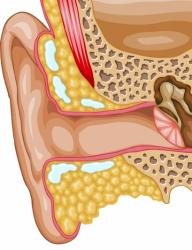 |
| Cerumen builds up in our ear canals |
Cerumen is produced by glands that line the outer third of the ear canal and it isn't wax at all. It's water-soluble (it dissolves in water) and it's there to collect dust, debris, dead skin cells, hair spray and all the other gunk that would, otherwise, work its way down the ear canal to the tympanic membrane or ear drum.
So, by capturing this gunk before it collects deeper in the ear, the delicate workings of the inner ear are protected. By reaming out ear wax with a cotton swab, toothpick or some other "entrenching tool," you're actually hurting yourself. Stop cleaning your ears - at least stop reaming out your ear canal with whatever's close at hand.
The American Academy of Otolaryngology - Head and Neck Surgery Foundation
The
AAO-HNSF (yes it's a mouthful) has issued new cerumen removal
guidelines for hearing care professionals; however, the guidelines
contain information that is useful for all to take home and stick inside
their medicine cabinet."Approximately 12 million people a year in the U.S. seek medical care for impacted or excessive cerumen," said Richard Rosenfeld, MD, MPH, Chair of the AAO-HNSF Guideline Development Task Force. "This leads to nearly 8 million cerumen removal procedures by health care professionals. Developing practical clinical guidelines for physicians to understand the harm vs. benefit profile of the intervention was essential."
You bet. And it's just as important that we all understand these new guidelines. It's a universal bodily function, but one that can cause problems, especially among special groups of people:
- 10% of children have problems with cerumen that require medical attention.
- 5% of adults have a problem serious enough for a visit to the doctor.
- 33% of the elderly have hearing issues associated with cerumen
- 33% of cognitively impaired men and women have problems.
What is so sticky about wax?
Well, the one most of us think about is cosmetic. No one wants to walk around with wax sitting in the outer ear. But a simple wash with warm water and soap will remove visible cerumen. Cosmetic problem solved, as long as the wash cloth stays outside the ear canal. If you use a wash cloth and stick to the pina - the outer ear - you'll look spiffy. And well groomed.Serious problems occur when cerumen builds up within the ear canal and becomes impacted or compressed. This can lead to a variety of problems: • ear pain • sound distortion (your own voice sounds different)
- a feeling of stuffiness or fullness in the ear canal
- persistent itching • an unpleasant odor
- ringing in the ears (tinnitus)
- discharge (an oozing substance that keeps appearing)
- persistent cough
- hearing loss
Let's put this in bold type because it's that important: if you experience any of the symptoms listed above and you know that you have ear wax build up, do NOT try to fix the problem yourself. REPEAT: Do not try to fix the problem yourself.
To put it simple, don't stick anything down your ear canal. The chances of pushing deeper the impacted cerumen are simply too great and worse, puncturing your eardrum (ouch!). And besides, you can't even see what you're doing in there so see a professional who can handle the problem safely.
The AAO-HNSF Cerumen Guidelines
So, what do the medical practitioners recommend for handling ear wax. Well, here are the new guidelines published by the AAO-HNSF:- Cerumen is beneficial. It is self-cleaning, protects the inner ear, moisturizes the ear canal and has anti-biotic properties, i.e. germs don't get through.
- People who wear hearing aids should be examined regularly for impaction that can cause feedback, limit hearing and cause further damage to the ear.
- Ear wax can cause reversible hearing loss even when 80% of the ear canal's diameter is blocked. (That's good news, so make an appointment today.)
- Removal techniques include:
- wax-dissolving agents (some o-t-c products are available for home maintenance)
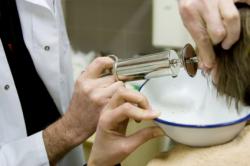 |
| Water irrigation is one cerumen removal option |
- irrigation - removing the impacted ear wax with water under mild pressure
- manual removal with special instruments
- suction, carefully controlled and monitored by the hearing professional
Take the advice of your physician or audiologist who may recommend regular visits for a safe ear cleaning.
Bottom line?
Cleaning your ears is not a do-it-yourself project like brushing your teeth. Your ears will take care of themselves under normal circumstances - no maintenance needed.
However, if you experience symptoms associated with ear wax impaction, or if you wear a hearing aid, the AAO-HNSF recommends seeing your hearing care professional every 6 - 12 months.
Dr. Peter Roland, MD, who led the team that developed these new hearing health guidelines put it this way. "The complications from cerumen impaction can be painful and ongoing, including infections and hearing loss. It is hoped that these guidelines will give clinicians the tools they need to spot an issue early and avoid serious outcomes."
Dr. Roland's point should be taken to heart, not only by hearing professionals but by individuals with cerumen problems. You know first when there's a problem with your hearing.
You're the best, strongest advocate for good hearing health. So, if ear wax is anything more unusual than "icky," make an appointment so see a hearing care professional today.
Sunday, 30 November 2014
Iodine Cures Cancers
We are about to upset the $50 Billion Cancer Industry.
Author Lynne Farrow asked me to post my research on how Iodine cures cancer.
First the real life stories from little Westport, Tn. I have been heavily promoting iodine to my friends & neighbors by handing out free books that I bought fromAmazon to get the ball rolling. I am even shocked at the amazing results I have seen in such short times.
1) Kay was suffering terminal cancer & was sent to home hospice to die when doctors gave up on her rapidly spreading cancer. She was given a 3 month death sustenance. Cancer had taken over her uterus & vagina, and spread out from there. Kay's best friend had cured her own fibrocystic breast disease in less than a month with iodine (her doctor wanted to do mastectomy), and was enthusiastic when I showed her my research on iodine curing cancer. Kay started the Dr. Brownstein iodine protocol, and was totally cured within 9 months. X-Rays proved all cancer was gone. She called us this week to tell us how well she is doing.
2) Our neighbor Glenda was suffering from Breast Cancer that was getting larger each month. Her sister, our mail lady, had also cured her own fibrocystic breast disease with iodine in less than 1 month, and so started Glenda on the Dr. Brownstein Iodine Protocol, and now just one month later, Glenda stopped over for a visit to tell us that her breast cancer had shrunk by 90% -
So just in our little community, we have cured 2 cases of fibrocystic breast disease, 1 terminal cancer & a 90% reduction in a breast cancer. The word is spreading like wildfire and over 30 people in this little community have jumped on the iodine bandwagon. Lynne Farrow's book is being passed around from one neighbor to the next, and my own file, "Iodine References" has become very popular.
http://tinyurl.com/Iodine-Handout.
I've heard these people want their own book and have been ordering it.
Now this was to be expected because of reports from leading doctors that iodine cures cancers. Too bad that mainstream medicine is ignoring them.
Dr. Derry says,”One drop (6.5 mg per drop) of Lugol's daily in water, orange juice or milk will gradually eliminate the first phase of the cancer development called fibrocystic disease of the breast so no new cancers can start.”
http://www.google.com/url?q=http%3A%2F%2Fthyroid.about.com%2Flibrary%2Fderry%...
Dr, Derry - How Iodine kills Cancer Cells
http://www.google.com/url?q=http%3A%2F%2Fiodine4health.com%2Fbody%2Fbreast%2F...
Dr. Dach, photos of tumors shrinking with 50mg Iodine
http://www.google.com/url?q=http%3A%2F%2Fjeffreydach.com%2F2009%2F11%2F13%2Fi...
Iodine & Breast Cancer, Dr. Dach
http://www.google.com/url?q=http%3A%2F%2Fwww.drdach.com%2FIodine_and_Breast_C...
There is much more in our "Iodine Recommended Reading," chapter Cancer.
http://goo.gl/G4dLP
Iodine is clearly a Miracle From God !
Grizz
Author Lynne Farrow asked me to post my research on how Iodine cures cancer.
First the real life stories from little Westport, Tn. I have been heavily promoting iodine to my friends & neighbors by handing out free books that I bought from
1) Kay was suffering terminal cancer & was sent to home hospice to die when doctors gave up on her rapidly spreading cancer. She was given a 3 month death sustenance. Cancer had taken over her uterus & vagina, and spread out from there. Kay's best friend had cured her own fibrocystic breast disease in less than a month with iodine (her doctor wanted to do mastectomy), and was enthusiastic when I showed her my research on iodine curing cancer. Kay started the Dr. Brownstein iodine protocol, and was totally cured within 9 months. X-Rays proved all cancer was gone. She called us this week to tell us how well she is doing.
2) Our neighbor Glenda was suffering from Breast Cancer that was getting larger each month. Her sister, our mail lady, had also cured her own fibrocystic breast disease with iodine in less than 1 month, and so started Glenda on the Dr. Brownstein Iodine Protocol, and now just one month later, Glenda stopped over for a visit to tell us that her breast cancer had shrunk by 90% -
So just in our little community, we have cured 2 cases of fibrocystic breast disease, 1 terminal cancer & a 90% reduction in a breast cancer. The word is spreading like wildfire and over 30 people in this little community have jumped on the iodine bandwagon. Lynne Farrow's book is being passed around from one neighbor to the next, and my own file, "Iodine References" has become very popular.
http://tinyurl.com/Iodine-Handout.
I've heard these people want their own book and have been ordering it.
Now this was to be expected because of reports from leading doctors that iodine cures cancers. Too bad that mainstream medicine is ignoring them.
Dr. Derry says,”One drop (6.5 mg per drop) of Lugol's daily in water, orange juice or milk will gradually eliminate the first phase of the cancer development called fibrocystic disease of the breast so no new cancers can start.”
http://www.google.com/url?q=http%3A%2F%2Fthyroid.about.com%2Flibrary%2Fderry%...
Dr, Derry - How Iodine kills Cancer Cells
http://www.google.com/url?q=http%3A%2F%2Fiodine4health.com%2Fbody%2Fbreast%2F...
Dr. Dach, photos of tumors shrinking with 50mg Iodine
http://www.google.com/url?q=http%3A%2F%2Fjeffreydach.com%2F2009%2F11%2F13%2Fi...
Iodine & Breast Cancer, Dr. Dach
http://www.google.com/url?q=http%3A%2F%2Fwww.drdach.com%2FIodine_and_Breast_C...
There is much more in our "Iodine Recommended Reading," chapter Cancer.
http://goo.gl/G4dLP
Iodine is clearly a Miracle From God !
Grizz
Wednesday, 1 October 2014
How To Prevent Hearing Loss?
Causes of Hearing
Loss
There are many causes of hearing loss that are beyond
our control, such as those caused by heredity. We can’t pick our parents and
our genetic make-up - though with continuing advances in gene
research , clinical applications, this may be changing. But for
now, we have to deal with the hand that heredity has dealt us.
In Some Cases,
Hearing Loss Can be Prevented
Ototoxic Drugs
These are
medications that are toxic to the ears and can cause hearing loss, sometimes
accompanied by tinnitus. We may have some options; however, about the
medications we take. It is always a good idea to ask a physician if a hearing
loss is one of the possible side-effects. If it is, and there is a substitute
medication that would work just as well, then that would be the one to take.
Examples of Otoxic Drugs
·
some over-the-counter drugs such as
aspirin in high doses
·
some antibiotics
·
some chemotherapy drugs
·
loop diuretics
·
some anti-inflammatory drugs
Signs of Ototoxicity (in
order of frequency)
·
Development of tinnitus in one or
both ears
·
Intensification of existing tinnitus
or the appearance of a new sound
·
Fullness or pressure in the ears
other than being caused by infection
·
Hearing loss in an unaffected ear or
the progression o an existing loss.
·
Development of vertigo or a spinning
sensation usually aggravated by motion which may or may not be accompanied by
nausea
Noise-Induced
Hearing Loss – Completely Preventable
·
A major cause of hearing loss in our
society is noise exposure. Tiny hair cells in the ear are damaged when assaulted by loud noise. Once those hair cells are destroyed they cannot be
replaced.
·
A noise-induced hearing loss is the
most common cause for its occurrence in our society and it’s completely
preventable.
·
Repeated and lengthy exposure to loud
sound – whether is it music or a jackhammer - will eventually produce a
sensorineural hearing loss.
Damage Risk Criterion
As the sound
level increases, the time span one can be exposed to it is reduced. Each day we
create more hearing losses in our society with our tolerance of the
ear-shattering cacophony that surrounds us.
One in Five Adolescents
Has Hearing Loss: Ear Buds May Be to Blame
·
According to a study in the Journal of the American Medical Association, August
17, 2010, “Listening to loud music though ear buds – the tiny electronic
speakers that fit into ears – is probably the main reason that more adolescents
are losing some of their hearing.”
·
“Once you have a hearing loss, there’s
a greater risk of that hearing loss progressing as you get older.” (Dr.
Slattery, USC, Los Angeles)
·
“Hearing loss may affect teens’
social development and education.” (Gary Curhan, M.D., associate professor of
medicine at Harvard Medical School)
·
Parents can begin monitoring use of
personal listening devices by their children. A good rule of thumb is that if
the child is wearing ear buds and the parent is able to hear the sound while
standing next to them, then the music is too loud.
Musicians
Musicians are
particularly at risk. It is their job to listen to the sounds that they and
their group are producing, and these may be as high as 135 dB. They have no
choice to do this as often as daily; this is their career and their livelihood.
Musicians
earplugs are available that can help. The newest and best version reduce the
sound equally all across the spectrum, from low to high frequencies. Everything
sounds just as good as it did before, only softer.
How to Reduce the Damage
to Hearing from Noise
Your ears can be
your warning system for potentially dangerous noises. The noise is too loud
when:
·
You have to raise your voice to be understood
by someone standing nearby
·
The noise hurts your ears
·
You develop a buzzing or ringing
sound in your ears, even temporarily (indicates some hair cells have died)
·
You don't hear as well as you
normally do until several hours after you get away from the noise.
How to Protect Yourself
When Around Loud Noise
·
Block the noise (wear earplugs or
earmuffs)
·
Avoid the noise (put hands over ears
if you can’t walk away)
·
Turn down the volume
Decibel Loudness
Comparison Chart
Painful
·
150 dB = fireworks at 3 feet
·
140 dB = firearms, jet engine
·
130 dB = jackhammer
·
120 dB = jet plane takeoff, siren
Extremely Loud
·
110 dB = maximum output of some MP3
players, model airplane, chain saw
·
106 dB = gas lawn mower, snow blower
·
100 dB = hand drill, pneumatic drill
·
90 dB = subway, passing motorcycle
Very Loud
·
80–90 dB = blow-dryer, kitchen
blender, food processor
·
70 dB = busy traffic, vacuum cleaner,
alarm clock
Moderate
·
60 dB = typical conversation,
dishwasher, clothes dryer
·
50 dB = moderate rainfall
·
40 dB = quiet room
Faint
·
30 dB = whisper, quiet library
Subscribe to:
Posts (Atom)